Motivation: on the tension between algebraic and bijective proofs
In the words of R. Stanley, the basic problem of enumerative combinatorics is that of counting the number of elements of a finite set.
Inside this area of mathematics, there exists a tension between two different ways to concoct a proof for a statement (Stanley goes through a thorough analysis of what it really means to answer the above problem). In the words of another combinatorialist,
In order to appreciate what a bijective proof is, consider the following identity:
There is an algebraic way of establishing this identity, namely observing that $\binom pk$ is the coefficient $[x^k](1+x)^p$, and similarly $[x^{n-k}](1+x)^q = \binom q{n-k}$; but then,
The claim now follows from comparing coefficients.
There is, however, another way to argue—the bijective way: the number $\binom pk$ is nothing but the cardinality of the set of injections $N \hookrightarrow P$, if $N$ is an $n$-set and $P$ is a $p$-set. Thus, the question we have is: why is the cardinality of the set of injections $N \hookrightarrow P+Q$ equal to the product of the cardinalities of the sets $\text{Inj}(K,P)$ and $\text{Inj}(N\setminus K,Q)$? In the category $\bf Set$, coproducts and monomorphisms are pullback-stable, so to determine an injection $f:N\hookrightarrow P+Q$, it is sufficient to determine the sets $I, J$ in the pullbacks:
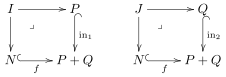
(The sets $I, J$ partition $N$: $I \cap J = \varnothing$, $I + J = N$.)
Enumerative combinatorics has a tension between these two complementary styles of proof. Somehow, one is close to an Erdősian style, and the other is more in the vibe of G.-C. Rota (but this is not intended as a judgment of quality).
Combinatorial species are the coronation of an attempt to unify these two perspectives, recognizing their respective limits and values, offering a unified framework in which the theory of generating functions (à la Wilf) can be framed and understood at a deeper level.
The theory was first introduced in two papers by A. Joyal:
- Joyal, André. Une théorie combinatoire des séries formelles. Advances in Mathematics 42.1 (1981): 1–82.
- Joyal, André. Foncteurs analytiques et espèces de structures. Combinatoire énumérative. Springer, Berlin, Heidelberg, 1986. 126–159.
which promoted, for a long time, the idea that the category $\bf Spc$ of combinatorial species is a categorified analogue of the semiring $\mathbb N\llbracket T\rrbracket$.
Exercise. Let $m\ge 1$ and $\vec n = (n_1,\dots,n_m)$ a vector of “dimensions”. Count in two ways the cardinality of the set $R_k$ for $k\ge 0$, defined as follows:
If you manage, congrats: you just found the rank of the (free) $k$-th cohomology $H^k(X_m,\mathbb Z)$ of the “general product of spheres” space $X_m := S^{n_1}\times S^{n_2}\times\dots\times S^{n_m}$!
Reading list
- Stanley, Richard P. What is enumerative combinatorics?. Enumerative Combinatorics. Boston, MA: Springer US, 1986. 1–63.
- Aigner, Martin. A Course in Enumeration. Berlin, Heidelberg: Springer Berlin Heidelberg, 2007.
- Joyal, André. Une théorie combinatoire des séries formelles. Advances in Mathematics 42.1 (1981): 1–82.
- Joyal, André. Foncteurs analytiques et espèces de structures. Combinatoire énumérative. Springer, Berlin, Heidelberg, 1986. 126–159.