Operads: more advanced results
Some of the structure of the category $\mathbf{Opd}$ of operads can be deduced from the fact that we are just looking at a particular instance of the category of monoids in a monoidal category.
Operads as monoids, and free constructions
Remark. There is an adjunction
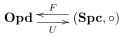
whence we can derive (among other things) that
- the category of operads is complete, and limits are created by the forgetful functor $U$; in particular, the Hadamard product of two species which happen to be operads inherits an operad structure (it is a straightforward consequence of a general fact, but it’s cool to see the derivation). Let $T_* : {\cal J} \to {\bf Opd}$ be a diagram of operads; then the limit $\text{lim}_{\cal J}\, T_J$ computed in species inherits a structure of operad as follows:
where $(\dag)$ precomposes with the diagonal functor $\Delta : {\cal J} \to {\cal J}^m$, and $(\ddag)$ uses the multiplication of each $T_J$; the unit is much easier to obtain, since $\eta_J : y1 \Rightarrow T_J$ is a cone, inducing a unique $\bar\eta : y1 \Rightarrow \text{lim}_{\cal J} T_J$ into the limit.
- colimits are complicated, but still they are reducible to certain reflexive coequalizers of free algebras, via the “Linton trick”.
One can define the free operad on a combinatorial species, i.e. a left adjoint to the forgetful functor $U$ above; the situation, however, is in stark contrast with the case of Cauchy monoids, because
- The Day convolution product is separately cocontinuous in both variables (compare this with the fact that the substitution product commutes with colimits in its left, but not in its right, component: $-\circ G$ is cocontinuous (and thus a left adjoint, given that $\bf Spc$ is a locally finitely presentable category; we proved this in lecture 3), while $F\circ-$ is not—and thus a right adjoint to it can’t exist).
- In the case of Day convolution, the free-forgetful adjunction is easy to characterize conceptually: the free Day-monoid on a species is $\sum_{n\ge 0} F^{*n}$, which reduces to the species $L\circ F$.
In order to prove that $L\circ F\cong \sum_{n\ge 0} F^{\ast n}$, first observe that $L = \sum_{n\ge 0} y(n)$, where $y(n)$ is the representable at $n$; so, since $-\circ F$ is cocontinuous, it is enough to prove that $y(n)\circ F\cong F^{*m}$, which is immediate: $L\circ F\cong \big(\sum_{n\ge 0} y(n)\big)\circ F\cong \sum_{n\ge 0} y(n) \circ F$, and
by Yoneda (equivalently, use the observation in the proof of existence of the substitution monoidal structure, $y(n)\circ F\cong y(1)^{\ast n}\circ F\cong (y(1)\circ F)^{\ast n}\cong F^{\ast n}$).
A not-so-helpful observation is that the free operad on $F$ has to be obtained as the initial algebra for the functor ${\bf Spc} \to {\bf Spc} : P\mapsto y1 + F\circ P$. Adamek’s theorem then ensures that such an initial algebra is the colimit of the chain
The problem is, we cannot develop such an expression by simplifying, since the substitution product is only left cocontinuous.
- In case $F$ is the species concentrated on an object $X$ at degree $n$, the free operad is associated to the free monad over the functor $X\times-$ (i.e. the free monad over said analytic functor); it’s the monad given by actions of the free monoid $X^\ast$ on $X$ as alphabet. The operad is obtained restricting its action to $\bf B$ along the inclusion $J$.
- In case $F=c_X$ is the species constant on an object $X$, the associated analytic functor sends a set $Y$ to the product $X\times \mathbb N[Y]$ of $X$ and the free commutative monoid (set of multisets) on $Y$. The free monad over this, restricted to $\bf B$ along $J$, yields the free operad over $c_X$.
Algebras for an operad
Monoids want to act on things, and to every category of monoids there is an associated category of modules; moreover, if $T$ is an operad, $T\circ-$ is obviously a monad on $\bf Spc$; thus, a (left) module for an operad then consists of an Eilenberg-Moore algebra for the monad $T\circ-$. It is a species $X$ together with a map $\xi : T\circ A \to A$, satisfying the $(T\circ-)$-algebra equations. In components, let $A(m)$ be the components of the species $A$; then the action is a map
which corresponds to
In such a situation, little more can be said in general. However, if $A(m) \equiv A_0$ is constant on a set $A_0$ (and with a bit of care, such constants can be defined on some bases of enrichment also for $\cal V$-enriched species), observe that $T\circ A$ is also constant (at the object $\int^m Tm\times A^m$) and thus the notion of algebra reduces to a single object $A$, with maps $\xi^{(m)} : Tm\times A^m \to A$ for all $m\in\bf B$, subject to certain equations (the cowedge condition, and natural compatibility with the monoid structure of $T$).
Remark. Compare this tension between a more natural, but elusive notion (a $T$-module understood as a species) and a more restrictive but also tame notion (a $T$-algebra understood as a single object), with a similar situation appreciated in monad theory: turning an operad $T$ into a monad $\flat T$ as in ref, a $T$-module is an analytic endofunctor equipped with a natural transformation $\xi : TA\Rightarrow A$, while a $T$-algebra is a single object equipped with a single arrow $\xi : TA\to A$. And indeed,
Remark. As such, the category of algebras for the operad $T$ is by definition the Eilenberg-Moore category for the monad $\flat T$ associated to $T$. Note that as a corollary, once the monad $\flat T$ associated to an operad is known, and $A$ is any set, the object $(\flat T)A$ is the (carrier of the) free $T$-algebra for the operad $T$.
Note also that since $-\circ A$ has a right adjoint for every species $A$ (even non constant), the algebra map $\xi$ is tantamount to a homomorphism of operads $\hat{\xi} : T \to \{A,A\}$, into the substitution-right-hom of ref. Note also that if $A$ is again constant at $A$, the species $\{A,A\}$ sends $m$ to ${\bf Set}(A^m,A)$.
An algebra (in the restricted, constant sense above) for the operad…
-
…${\tt End}(P)$ of endomorphisms for the species $P$ consists of a set $X$ equipped with maps $\xi^{(m)} : \{P,P\}(m)\times A^m \to A$, i.e. a map of type $\xi^{(m)}_n : \int_r {\bf Set}(P^{\ast m}r,Pr)\times A^m \to A$ if $P$ is itself constant at $P_0$, this expression simplifies into $\xi^{(m)}_n : {\bf Set}(P^m_0,P_0)\times A^m \to A$ evidently then, $P_0$ is an algebra for the operad $\{P_0,P_0\}$, and the algebra map is given by the adjoint of the identity of $[P_0,P_0]$.
-
…$\tt Com$ (or $\tt Com_+$) (having carrier $E$ (or $E_+$), see lecture 9) consists of a family of maps $E(m)\times A^m \cong A^m\to A$, i.e. an $m$-ary operation $\xi^{(m)} : A^m \to A$ for every $m\ge 0$, each of which is completely symmetric, meaning $\xi^{(m)}(a_1,\dots, a_m) = \xi^{(m)}(a_{\tau 1},\dots, a_{\tau m})$ for every $\tau \in S_m$. In fact, one can prove that the operations of arity $m\ge 2$ are reducible to $\xi^{(2)} : A\times A \to A$ (which together with the associativity request, equips $A$ with a commutative semigroup structure -for $E_+$- or monoid -for $E$-). Reasoning via the associated analytic functor, an algebra for the associated monad is a commutative monoid (or semigroup). The trick to represent the unique element ${a_n} \in E(n)$ as a little $n$-ary spider now comes very handy: the operad axioms now prove that for every $m\ge 3$, $\xi^{(m)}$ is a composition of $\xi^{(2)}$’s and identities, and $\xi^{(2)}$ is a commutative semigroup/monoid operation on $A$.
-
…$\tt As$ (or $\tt As_+$) (having carrier $L$ (or $L_+$), see lecture 9) consists of a family of maps $\xi^{(m)} : S_m\times A^m \to A$; an element $(\sigma;(x_1,\dots,x_m))$ can be thought of as a linear order on its second component: $x_{\sigma 1} < \dots < x_{\sigma m}$, in such a way that $\xi^{(m)}(\sigma;\vec x)$ prescribes the product of the $x_i$’s in the order specified by $\sigma$; again, the operations of arity $m\ge 2$ are reducible to $\xi^{(2)} : A\times A \to A$. Reasoning via the associated analytic functor, an algebra for the associated monad is a monoid (resp., a semigroup). Using again the operad axioms, $\xi^{(2)}$ is a (noncommutative) monoid/semigroup. (the “Ass” is a shortening of “ass”ociative ($\boldsymbol k$-)algebra, which is the structure of an $L$-algebra in a $\boldsymbol k$-vector setting).
-
(many other examples are possible…!)
Operads and Lawvere theories
One can obtain, from a similar recipe, Lawvere theories as monoids in a substitution-monoidal category: $[{\bf Fin},{\bf Set}]$ (as in lecture 1).
However, Lawvere theories are strictly more general than operads precisely because they are necessarily formulated in a cartesian monoidal setting (whereas operads live in a symmetric monoidal setting without diagonals).
Concretely, operads encode only operations with many inputs and a single output, and their composition mechanism enforces linearity of variables: each input is used exactly once. As a result, operads cannot express structural operations such as duplication (diagonals), deletion (projections), or arbitrary reuse of variables (so, for example, it is impossible to write $x\mapsto (x,x)\mapsto (x,x^{-1})\mapsto x⋅ x^{-1}$, to the effect that there is no operad whose algebras are groups).
Lawvere theories, by contrast, freely allow operations with multiple outputs and are equipped with canonical diagonal and projection maps, making it possible to model algebraic theories where variables may be copied, discarded, or reused. This additional expressive power is essential for capturing most classical algebraic structures—such as groups, rings, lattices, and Boolean algebras, which fundamentally rely on equations involving variable duplication or weakening and therefore lie beyond the expressive scope of operads.
More precisely, a Lawvere theory is obtained as follows, mimicking the recipe that yielded operads in the previous lecture:
- Start with ${\bf Fin}$ and its Cartesian monoidal structure;
- Equip the category $[{\bf Fin},{\bf Set}]$ with the Day convolution product, but observe that since its domain is Cartesian monoidal, this monoidal structure collapses into the Cartesian monoidal structure on $[{\bf Fin},{\bf Set}]$;
- thus the iterated Day convolution boils down to $F\mapsto F^{\times n}$;
- thus, one can define a substitution product, via the equivalence $[{\bf Fin},{\bf Set}] \cong [{\bf Set},{\bf Set}]_\omega$ (between finitary functors, and functors in $[{\bf Fin},{\bf Set}]$) given by left Kan extension along $J : {\bf Fin} \to {\bf Set}$: note that ow $J$ is fully faithful, and this makes all the difference.
- An “operad” in this setting is a $\circ$-monoid where if $F,G : [{\bf Fin},{\bf Set}]$ are two functors, the substitution $F\circ G$ is defined as
Non-symmetric operads of sets correspond exactly to Lawvere theories that possess a strongly regular presentation, where an algebraic theory is defined as “strongly regular” if it can be presented by operations and equations where the same variables appear on each side of the equals sign, in the same order, and without repetition. Under this classification, the theory of monoids and the theory of semigroups are considered strongly regular and thus can be described by operads. In contrast, the theories of groups or commutative monoids are not strongly regular; their defining equations either permute the order of variables, omit variables, or repeat them, which prevents them from being modeled by non-symmetric operads.
Leinster studied whether operads can be strictly identified as a special class of monads, finding that they are not: the functor which maps a non-symmetric operad to its induced monad does not reflect isomorphisms. Consequently, two non-isomorphic operads can generate isomorphic monads, which implies that the passage from an operad to its category of algebras involves a loss of structural information.
Leinster defines the “reverse” of an operad $P$, denoted $P^{rev}$, with the same carrier and the same identity element $u\in P(1)$, and composition law defined by reversing the order of the sub-operations: $\theta \circ^{rev} (\theta_1, \dots, \theta_n) = \theta \circ (\theta_n, \dots, \theta_1)$. He then proceeds to demonstrate that a natural isomorphism $\iota: \flat P \cong \flat (P^{rev})$ exists between the monad induced by $P$ and the monad induced by $P^{rev}$. This isomorphism $\iota_X$ functions by reversing the order of the elements in the $n$-tuple of $X$: $(\theta, x_1, \dots, x_n) \mapsto (\theta, x_n, \dots, x_1)$. This construction proves that every operad is “Morita equivalent” to its reverse, as they share isomorphic categories of algebras, even if the operads themselves are not isomorphic.
The paper identifies a specific operad $P$ that is not isomorphic to its reverse $P^{rev}$. This operad is constructed where $P(n)$ consists of $n$-tuples of order-preserving continuous maps $f_i: [0, 1) \to [0, 1)$ such that the images are strictly ordered ($i < j \implies f_i(t_i) < f_j(t_j)$). The composition in this operad is defined by the functional composition of these maps.
Leinster proves $P \not\cong P^{rev}$ by identifying a structural property that is invariant under isomorphism but holds for $P$ and fails for $P^{rev}$. He defines “constant” and “surjective” elements within an operad based on their behavior under composition.
- There exist a binary operation $\phi \in P(2)$ and a constant unary operation $\gamma \in P(1)$ such that the composite $\phi \circ (\gamma, id)$ is surjective. This is achieved in $P$ by letting $\gamma$ and the first component of $\phi$ be constant maps to 0, while the second component of $\phi$ is the identity map.
- In the reverse operad, the same configuration requires analyzing the composite $\phi \circ (id, \gamma)$ in the original operad $P$. Because of the order-preserving nature of the maps, the image of such a composite is restricted to a sub-interval $[0, f_2(b))$, which prevents it from being surjective.
For symmetric operads, the situation is fundamentally different: there is an equivalence between the category of symmetric operads and the category of analytic monads (and weakly cartesian maps). This indicates that while symmetric operads can be identified as monads of a specific type, non-symmetric operads contain internal directional data that the induced monad fails to preserve.
Remark (Operads and virtual species). An operad in the category of virtual species is a virtual species $\Phi$ that satisfies the requirements of a monoid with respect to the substitution product. This structural definition requires a composition morphism $\gamma: \Phi \circ \Phi \to \Phi$ and a unit morphism $\eta: X \to \Phi$ that fulfill the associativity and unit axioms within the ring $Virt$.
The introduction of virtual species provides results for operadic structures that are not possible in the semi-ring of ordinary species. Specifically, every virtual species $G$ where $G(0) = 0$ and $G^\prime(0) = 1$ possesses a unique substitutional inverse $G^{\langle -1 \rangle}$. This inverse satisfies the identities $G \circ G^{\langle -1 \rangle} = X$ and $G^{\langle -1 \rangle} \circ G = X$. This allows for the explicit resolution of combinatorial functional equations of the form $F = A \circ \Psi$, where the solution is determined as $\Psi = A^{\langle -1 \rangle} \circ F$. For instance, the species of rooted trees $A$ has a substitutional inverse $A^{\langle -1 \rangle} = X \cdot E^{-1}$, which is used to define the virtual species $\Lambda = X + E_2 - X^2$ in the context of the dissymmetry theorem for trees.